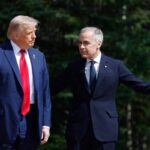






OTTAWA – Only a few months after Mark Carney took office as Prime Minister, more Canadians are saying they regret supporting him at the polls. While Carney campaigned on a promise to push back against U.S. President Donald Trump’s tough trade tactics, many now see his strong words as empty.
Instead of the bold defence he promised, critics say Carney has backed off, leaving the country facing economic trouble and growing doubt.
Carney ran as the candidate with the economic skills to go head-to-head with Trump, making a new trade and security pact with the U.S. the centrepiece of his campaign. But that agreement has not happened. Instead, Canada is facing higher tariffs from the U.S., with a new 35% tax on all Canadian goods set to start on August 1 after Trump issued an ultimatum.
This failure to secure a deal has led to frustration and a sense of betrayal among Canadians who believed Carney would be a strong negotiator in tough times. “We voted for Carney because he said he’d fight for us,” shared Sarah Mitchell, who runs a small business in Toronto.
“Now it feels like he’s walked away, and we’re the ones getting hurt.”
Change in Approach, Growing Criticism
During the 2025 campaign, Carney promised to stand firm against U.S. tariffs, which started at 25% on Canadian goods and later rose to 50% on steel and aluminum. His tough talk, including saying that Canada’s close friendship with the U.S. was “over,” struck a chord with voters wary of American influence.
Since taking office, though, Carney’s approach has softened. Many now criticize him for making concessions that have not improved the situation.
One move that drew anger was Carney’s decision to drop the Digital Services Tax on American tech companies. He said this was part of a larger negotiation, but Trump answered by doubling tariffs on Canadian metals and threatening more penalties.
Online, users like @Additives_ca on X accused Carney of collapsing under pressure. Political experts, including Blayne Haggart in The Globe and Mail, called the push for a full trade deal unrealistic, saying Carney failed to understand the political motives behind the U.S. trade stance.
Vacation During Key Negotiations
Public frustration grew when news broke that Carney was on vacation in the Ottawa area as trade talks stalled. As the July 21 deadline for a deal approached (later moved to August 1 after a new letter from Trump), many were upset to see their prime minister away from the table.
“Vacation days: unlimited,” joked @MarcNixon24 on X, highlighting the sense that Carney was out of touch. For many who saw him as a steady leader, his absence at such a key time deepened feelings of disappointment.
Canada’s economic challenges are growing. The country sends about 75% of its exports to the U.S., so any trade dispute has big consequences. Recent numbers from Statistics Canada show inflation rising to 1.9% in June, with car prices jumping due to Trump’s 25% tariff on vehicles.
Orders for Canadian exports are dropping at one of the fastest rates ever, according to S&P Global, showing a sharp downturn in trade. @MelissaLMRogers posted on X, “Carney is negatively impacting Canada at this point. Big time.”
GDP growth, which was already low at 1.9% per year, could fall to 1.1% if the trade fight continues, according to Oxford Analytica. This would make Canada one of the weakest G7 economies, a far cry from Carney’s promise to make Canada “the strongest economy.”
Confidence Drops
Recent polls show that public trust in Carney is slipping. An Angus Reid poll found Canadians split, with 46% still confident in Carney’s ability to deliver a trade deal, while 45% have lost faith. This is a sharp drop from the 86% support he saw during the Liberal leadership race.
Some point to Trump’s unpredictable style, but over half of those lacking confidence think Carney isn’t up to the job. “He promised to stand up to Trump, but all we’ve seen is concessions and delays,” said James Lee, a factory worker from Edmonton.
Some still support Carney, saying it’s too soon to judge his actions. Roland Paris, a former adviser on Canada-U.S. relations, says the outcome of the talks will matter most. Others, like Fen Hampson at Carleton University, point out that American consumers also get hit by tariffs, which could give Canada some bargaining power.
But with no agreement in sight and the economy getting worse, patience is running low.
Carney is set to meet with provincial leaders on July 22 to talk about the ongoing trade fight. Pressure is rising for him to show results. His plans to lower trade barriers inside Canada and boost investment in housing and clean energy haven’t produced clear benefits yet.
Conservative Leader Pierre Poilievre and other critics keep reminding voters that Carney has not lived up to his promise of an “elbows up” approach. With the August 1 deadline approaching, Canadians are watching closely to see if their prime minister can turn things around—or if regret over their vote will keep growing.