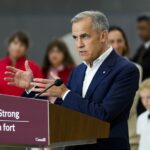






WASHINGTON, D.C. – U.S. President Donald Trump’s support for Canadian Prime Minister Mark Carney before the April 28 election highlights an interesting political pattern, according to well-known historian and conservative commentator Victor Davis Hanson.
Hanson explained that Trump’s backing of another Liberal leader in Canada and his repeated compliments about Carney may reflect how strong political rivals sometimes interact more directly. Speaking with Jan Jekielek on The Epoch Times’ “American Thought Leaders,” Hanson said that when two leaders hold very different views, their exchanges often become more open and honest.
Hanson suggested Trump might act with more caution if Pierre Poilievre, the Conservative leader, had become prime minister. With someone seen as a political ally, Trump would likely choose his words more carefully. “But when it comes to someone on the other side, like a Liberal, you can be more frank,” Hanson said. He believes Trump feels more comfortable being direct with Carney.
Trump’s Public Support for Carney
Before the Canadian election, Trump expressed a clear preference for dealing with a Liberal prime minister rather than a Conservative. He told Fox News that Poilievre had made negative remarks about him and was “no friend of mine.” Trump added, “I think it’s easier to deal with a Liberal, and maybe they’ll win, but it doesn’t matter to me.”
Trump previously said he didn’t support Poilievre, calling him “not a MAGA guy.” Poilievre responded publicly, saying, “I am only for Canada, and if that upsets foreign leaders, I am fine with that.”
During his campaign, Carney often spoke out against Trump, claiming, “Trump is trying to break us, so that America can own us.”
In that same Fox News interview, Trump described dealing with Justin Trudeau and his team as difficult, calling them “nasty.”
After Carney’s win, Trump praised him as “a very nice gentleman” and soon announced Carney’s visit to the White House. When the two leaders met on May 6, Trump called Carney “a very talented person” and said Carney’s win was “one of the greatest comebacks in the history of politics, maybe even greater than mine.”
Trump later commented that both Carney and Poilievre disliked him, but “it was the one that hated Trump, I think the least, that won.” He also said Poilievre disliked him even more than Carney.
Hanson pointed out that a Liberal prime minister is more likely to face clear U.S. demands, such as on defence spending. Hanson said that confronting a Conservative about falling short would be more awkward or uncomfortable, while telling a Liberal creates different pressure.
Trump’s Approach Seen as Strategy
Brian Lee Crowley from the Macdonald-Laurier Institute offered his view, saying Trump’s praise for Carney is more about strategy than genuine admiration. Crowley explained that Carney’s background—a top university degree, roles as a central banker in Canada and the UK, and ties to the World Economic Forum—doesn’t fit the type of person Trump typically respects.
Crowley also mentioned Carney’s ties to China and said past Liberal governments have tried to build closer relations with China, which he believes is not in line with U.S. interests. However, Crowley argued Carney has little choice but to work closely with Washington, as Canada depends heavily on the U.S.
Carney has faced criticism from Conservatives over a large loan Brookfield Asset Management received from China’s state-owned bank while he chaired the company. Conservatives also pointed to Carney’s October 2024 meeting with Beijing’s mayor, where he discussed business expansion and cooperation.
Carney responded during the campaign, saying he is “beholden to absolutely no one except the Canadian people.” He named China as Canada’s biggest security threat and stated that China is not among the trading partners who share Canada’s values. Carney also stressed the need for caution and high standards in trade with China.
Crowley said Trump likely sees Carney as a negotiating partner he can outmaneuver and questioned whether Carney can resist Trump’s approach. He added, “I don’t think [Carney] has a lot of options, and Trump is fine with that.”
Canada’s Response to U.S. Concerns
Hanson said Canada under Trudeau was less responsive to U.S. concerns than some other allies, such as Mexico. He pointed to ongoing tension over border issues, suggesting that Canada had not done enough to address illegal crossings and drug smuggling into the U.S.
In response, Ottawa set aside $1.3 billion last year to boost border security. The government also appointed a “fentanyl czar,” labelled several transnational criminal groups as terrorist organizations, and allocated another $200 million to strengthen security operations.
The Prime Minister’s Office stated in January that the Canada-U.S. border accounted for less than 0.2 percent of the fentanyl seized by U.S. authorities.
However, FBI Director Kash Patel said last week that fentanyl is entering the U.S. from Canada, with help from groups in China, Russia, and Iran. According to Patel, smugglers are using Vancouver as a main entry point.
This overview reflects how both Trump and Canadian leaders approach their relationship, with a mix of strategy, public statements, and ongoing debate over each country’s interests.