





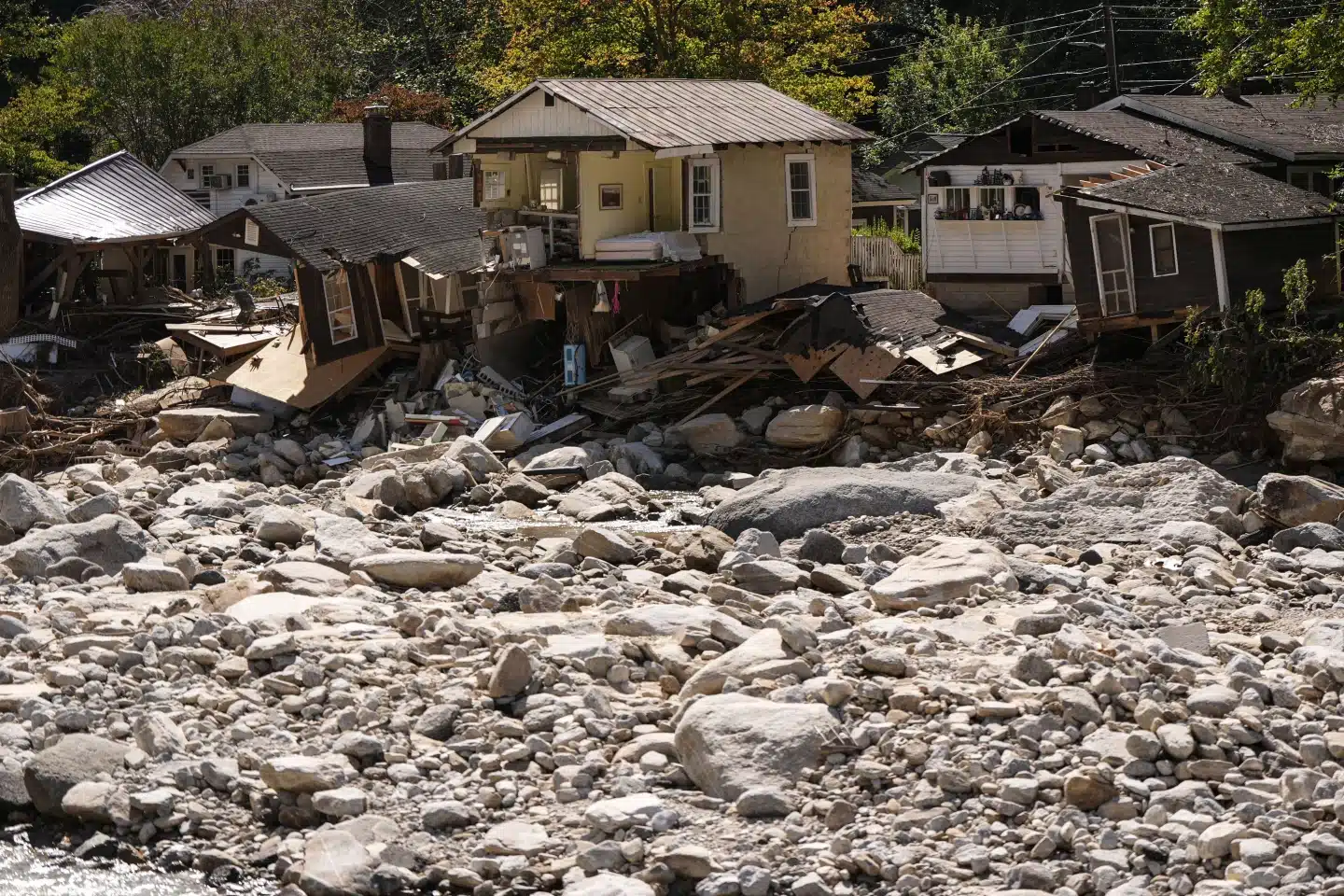
A week after Hurricane Helene devastated the Southeastern United States, residents in the hardest damaged areas are wondering how they will pay for the water damage caused by one of the deadliest storms to hit the mainland in recent history.
The Category 4 storm that hit Florida’s Gulf Coast on September 26 has dropped trillions of gallons of water across numerous states, leaving a devastation trail that stretches hundreds of miles inland. According to the National Hurricane Center, more than 200 people have died in what is now the deadliest hurricane to strike the continental United States since Katrina.
Western North Carolina and the Asheville area were particularly heavily struck, with water destroying buildings, roads, utilities, and property in ways that no one expected, let alone prepared for. Inland areas in Georgia and Tennessee were also flooded out.
The Oak Forest neighborhood in south Asheville stands up to its name, with trees towering over 1960s ranch-style houses on spacious lots. But on September 27, as Helene’s leftovers passed across western North Carolina, many of those trees fell, occasionally hitting houses.
Julianne Johnson said she was walking upstairs from the basement to help her 5-year-old son pick out clothes when her husband started yelling about a massive tree falling crosswise across the yard. The tree mostly avoided the house, although it did crush a portion of a metal porch and damage the roof. Then, Johnson claimed, her basement flooded.
Homeowners Hit By Hurricane Helene Face The Grim Task Of Rebuilding Without Flood Insurance
On Friday, a blue tarp was secured to the roof with a brick. The sodden carpet that the family had taken out sat on the side of the house, awaiting disposal. Johnson stated that she was unable to file a house insurance claim until four days after the storm due to a lack of cell phone connection and internet.
“It took me a while to make that call,” she explained. “I don’t have an adjuster yet.”
Roof and tree damage are typically covered by the average house insurance policy. Johnson, like many homes, does not have flood insurance, and she is unsure how she would pay for that portion of the damage.
Those recovering from the storm may be startled to hear that water damage is a separate issue. Insurance professionals and experts have long warned that home insurance often does not cover flood damage to a home, even though flooding can occur anyplace it rains. Flooding is caused by more than just seawater seeping into the land; it also includes water from banks, mudflows, and excessive rainfall.
However, most private insurance firms do not offer flood insurance, making the Federal Emergency Management Agency’s National Flood Insurance Program the principal supplier of coverage for residential homes. Congress established the government flood insurance program more than 50 years ago after many private insurers discontinued issuing policies in high-risk areas.
According to FEMA’s most recent data, North Carolina has 129,933 such policies in place, however, the majority of that protection will likely be located on the coast rather than in the Blue Ridge Mountains, where Helene inflicted the most damage. In comparison, Florida has over 1.7 million flood policies in place across the state.
Charlotte Hicks, a flood insurance expert in North Carolina who has led flood risk training and educational outreach for the state’s Department of Insurance, believes that many Helene survivors will never be fully compensated. Without flood insurance, some people may be able to rebuild with the assistance of charitable organizations, but the majority would be left to fend for themselves.
“There will absolutely be people who will be financially devasted by this event,” Hicks said to the audience. “It’s heartbreaking.”
Some may face foreclosure or bankruptcy. Entire neighborhoods will most likely never be restored. According to Hicks, there has been widespread water damage, and for others, mudslides have even stolen the land where their house once stood.
Meanwhile, Helene is proving to be a more manageable disaster for the private home insurance market, as those policies typically only cover wind damage from storms.
This is a relief for the sector, which has been under increasing pressure from other worsening climate disasters like wildfires and tornadoes. Nowhere is the declining private market due to climate instability more visible than in Florida, where many companies have already stopped offering coverage, leaving the state-backed Citizens Property Insurance Corporation as the state’s largest insurer.
According to Mark Friedlander, a representative for the Insurance Information Institute, Helene is a “very manageable loss event,” with insurer losses estimated to be between $5 billion and $8 billion. This is in comparison to the insured losses from Category 4 Hurricane Ian in September 2022, which were anticipated to cost more than $50 billion.
According to Friedlander and other experts, less than 1% of the inland communities that saw the most catastrophic flood devastation have flood insurance coverage.
“This is very common in inland communities across the country,” Friedlander explained. “Lack of flood insurance is a major insurance gap in the U.S., as only about 6% of homeowners carry the coverage, mostly in coastal counties.”
Amy Bach, executive director of the consumer advocacy group United Policyholders, said the photos of flood destruction in North Carolina horrified her, despite decades of witnessing the difficult recovery journeys of natural disaster survivors.
“This is a significant situation in terms of people being disappointed. They will be disappointed in their insurers as well as FEMA,” Bach stated. “FEMA cannot match the kind of dollars private insurers are supposed to be contributing to the recovery.”
Homeowners Hit By Hurricane Helene Face The Grim Task Of Rebuilding Without Flood Insurance
This Monday, FEMA said that it could handle Helene’s urgent needs, but warned that it does not have enough resources to last through the hurricane season, which runs from June 1 to November 30, despite the fact that most hurricanes occur in September and October.
Even if a homeowner has it, FEMA’s National Flood Insurance Program only provides up to $250,000 for single-family houses and $100,000 for possessions.
Bach stated that in addition to homeowners educating themselves on what their policies cover and do not cover, the solution is a national catastrophe insurance program that functions similarly to the Affordable Care Act for health insurance.
Following Hurricane Floyd in 1999, the state of North Carolina began requiring insurance agents to take a flood insurance class so that they could appropriately advise their clients on the risk and available policies, according to Hicks. The state also requires home insurance policies to clearly mention that they do not cover floods.
“You can’t stop nature from doing what nature is going to do,” Hicks pointed out. “To believe that things will never be this awful again is a hazardous assumption. Many people underestimate their risk of flooding.
SOURCE | AP