




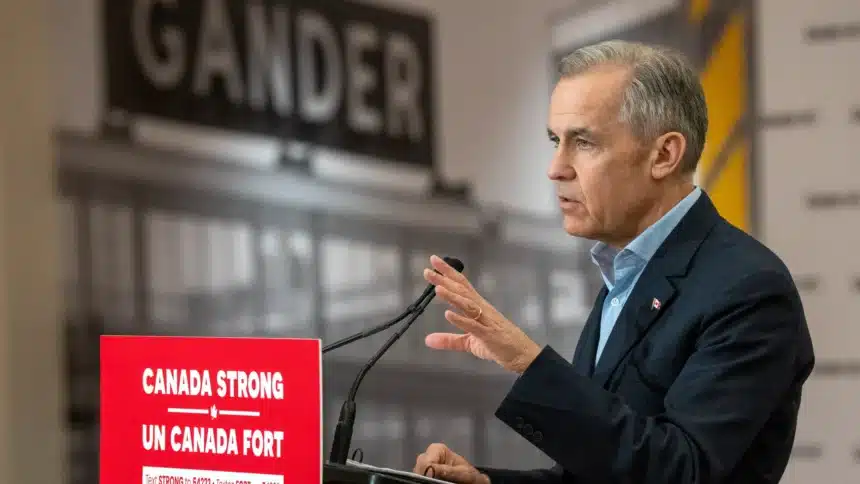
OTTAWA – In the cool fall of 2025, as Ottawa’s trees turned, frustration spread through Canada’s industrial core. Prime Minister Mark Carney, an Oxford-educated economist who won on anti-Trump energy, became the focal point of national anger.
He took office with a slim minority in April, buoyed by a patriotic surge after Donald Trump’s tariff threats and annexation taunts. He promised elbows-up diplomacy, tough talks, and protection for Canadian jobs. Six months later, after his October 7 White House visit, critics say he sacrificed auto and softwood lumber workers.
Union jobs are disappearing, unemployment is rising, and voters see a Liberal government more eager for high-level smiles than job security. With a housing crunch, rising debt, and a deficit expected to top $100 billion, regret among Liberal supporters is growing. Carney’s concessions to Trump delivered no clear wins, and ordinary people are paying the price.
Carney’s rise mixed economic credentials with geopolitical risk. The former head of the Bank of Canada and the Bank of England entered the Liberal leadership in January 2025, after Justin Trudeau resigned during a trade war flare-up. The Liberals trailed the Conservatives by 20 points.
Then Trump’s tariffs landed in February, hitting Canadian steel, aluminum, autos, and later softwood lumber. A nationalist wave followed. Carney cast himself as the calm fixer, dismissed Trump’s annexation chatter as “crazy,” and vowed to beat the U.S. on trade. He won in April with 169 seats, short of a majority, but hailed as a comeback.
“Canada never, ever will be part of America,” he declared on election night, blending hockey grit with foreign policy. By late summer, the glow faded. Tariffs hurt more each month, and the earlier talk sounded empty.
Carney Capitulates to Trump
The October 7 White House meeting was billed as a working session to reset ties and focus on security and trade. Trump praised Carney as a “world-class leader” and a “tough negotiator,” but the compliments hid a lopsided outcome.
No tariff relief arrived. Instead, Carney removed many of Canada’s retaliatory measures on U.S. steel and autos. To critics, this looked like a surrender made in advance. Trump teased possible talks about reviving Keystone XL, then slapped a new 10% tariff on softwood lumber, pushing combined duties above 45%.
Carney insisted Canada would accept only the best deal on lumber, yet those words sounded like recycled bravado. Auto executives tempered hopes before the visit, then left Washington with nothing to show. They warned that more cuts could follow. Carney got photos and warm words. Canada got nothing.
The auto sector shows the pain most clearly. It is central to Ontario’s economy and employs over 125,000 people. Trump’s 25% tariff on vehicles in April triggered shutdowns and layoffs. Stellantis idled its Windsor Assembly plant for two weeks in early April, issuing layoff notices to 4,500 workers, most of them Unifor members.
The shock rippled to 12,000 jobs. General Motors followed, cutting 750 jobs at Oshawa in May while retooling for trucks amid tariff uncertainty. By June, GM halted production at Ingersoll’s CAMI Assembly and laid off 500 of 1,200 workers through May.
Unifor President Lana Payne called it a “crushing blow,” saying tariffs were wrecking North American supply chains. These are not statistics on a spreadsheet. They are union jobs that supported families in Windsor and Oshawa. Today, idled workers line up for EI, unsure what comes next.
Softwood lumber looks just as bleak. The sector, crucial to rural communities in British Columbia and Quebec, has battled U.S. duties since 2017. Trump’s latest hikes, now over 35% combined, landed like a knockout.
Mass Layoffs and Shutdowns
In June, Quebec producer Groupe Rémabec announced “temporary” layoffs for 1,000 of its 2,000 workers, citing weak demand and punitive tariffs. B.C. mills cut output by about 12%. Interfor Corp. reduced shifts and extended shutdowns that hit hundreds of staff.
United Steelworkers’ Jeff Bromley warned of serious damage and predicted permanent closures as U.S. homebuilding cools. These are skilled union roles that keep small towns alive, from harvesters and sawyers to truckers. Carney’s post-meeting statements offered no relief. His government floated $1.2 billion in forestry aid, but critics called it a Band-Aid on a severe wound.
As factories slowed, the jobless rate rose to 7.1% in August, the highest since 2016 if pandemic years are excluded. Youth unemployment hit 17.9% over the summer, the worst since 2009. Windsor’s rate climbed to 11.1%. Oshawa’s reached 9%. These are not abstract figures. Families skip meals. Graduates move from couch to couch. Main Streets empty out. Carney’s line about getting the “best deal possible” sounds thin beside a wall of pink slips.
Public anger at the Liberals has boiled over. Before the election, Carney led Pierre Poilievre by 14 points on the economy, lifted by anti-Trump sentiment. That edge vanished after Washington. X (formerly Twitter) lit up with #CarneyCaved. Users called him a coward who sold out workers for elite social time.
Poilievre jabbed at Carney’s “0-3 slump”: no tariff win, no elbows up, no growth. Even some Liberals mutter regret. One post summed it up, saying many Liberals now think Carney is getting rich while voters struggle. Polls show the Liberal lead disappearing.
Sixty percent of Conservatives and 40% of undecided voters see Carney as weak on Trump. In ridings such as Nepean, people complain that his constituency office is not reachable. The leader who vowed to “build Canada strong” now faces charges of betrayal.
Lining His Own Pockets
Claims that Carney is “lining his own pockets” tie back to his pre-political career. He is a multimillionaire with past ties to Brookfield Asset Management and global finance circles. During the Trump meeting, he talked up Canadian investment in the U.S., saying it was “a half-trillion in the last five years, probably a trillion in the next.”
Critics ask who gains from that money, Bay Street or Main Street. The sentiment on X echoed this theme. Carney dropped his British and Irish citizenships before taking office, which backers framed as patriotic. Skeptics saw a global figure shedding baggage to secure power. In a country wrestling with inequality, this story sticks. Workers line up at food banks, while some imagine Carney savouring Vance-family tiramisu.
Domestic pressures add to the strain. Housing shortages are at crisis levels. The Canada Mortgage and Housing Corporation says Canada needs 430,000 to 480,000 new homes each year through 2035 to restore affordability. Yet housing starts stalled at 279,510 in May, as tariff shocks chilled investment.
Prices in Toronto and Vancouver remain sky high. Median homes cost about 12 times the income. Young people are disheartened. Debt deepens the pain. Federal net debt sits at $1.352 trillion, about $32,764 per person. Interest costs will reach $92.5 billion in 2024–25, which crowds out social programs.
The fiscal outlook adds another hit. The deficit is now expected to exceed $100 billion this year, double the $42 billion forecast, about 3% of GDP. National Bank economist Stefane Marion links it to Carney’s major projects push, including $400 million in loans to steel firms and broad infrastructure promises.
Canadians Facing Hard Choices
Through July, the year-to-date shortfall reached $7.79 billion, with spending outpacing revenue. Critics call it Trudeau-era spending on steroids. EI flexibilities prevented about 11,000 layoffs, but masked deeper problems. With debt service rising, how much room is left for retraining, housing, or regional supports?
Carney’s allies say he is walking a tightrope. They argue he avoided an escalation and is building long-term strength. His Major Projects Office, launched in August, promises one project, one review. It is meant to speed up resource and infrastructure approvals and draw investment.
Without tariff relief, the plan feels like whistling past a graveyard. X users captured the mood in plain terms: Carney promised to be tough, then returned empty-handed. In diners around Windsor and in B.C. mill towns, the sense of betrayal runs deep. In union halls, talk of shifting votes grows louder, as Poilievre’s “common sense” message gains momentum.
Canada faces a hard choice. Carney’s climbdown has drained trust, and with it, hope. The auto and lumber workers pushed aside by tariffs are not just numbers. They are the backbone of a middle class now at risk. The deficit is swelling, and homes are scarce, so Liberal regret is spreading. Carney took office promising to build big and build now. Instead, resentment has grown.
Unless real wins arrive soon, the 2025 election miracle could become a 2029 epitaph. For now, Canadians are not only angry. They are taking stock of what it costs when diplomacy bends without results. Elbows upturned into hands up in surrender.