




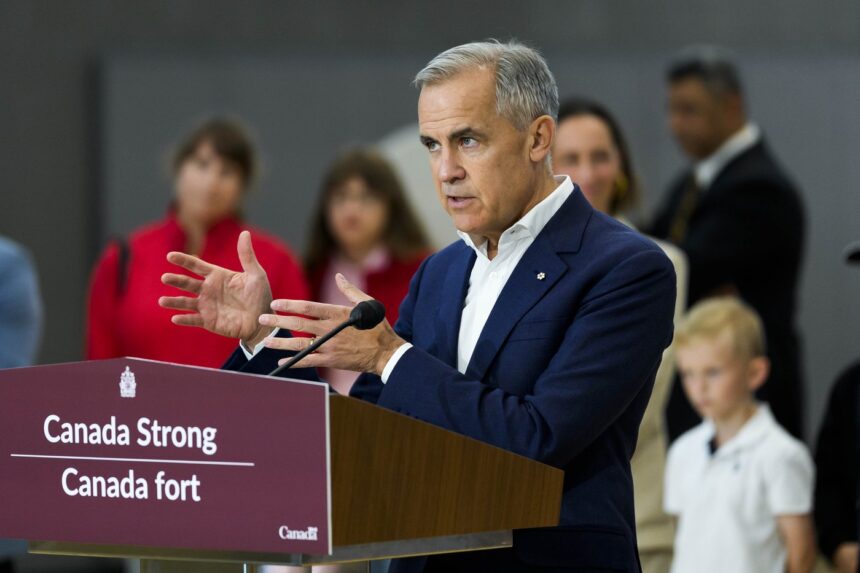
OTTAWA – With Canada’s economy close to stalling, Prime Minister Mark Carney stood in a modest community centre in Nepean and rolled out a headline plan. He promised an “automatic tax filing” system for the 2026 tax year, aimed at low-income Canadians who miss out on credits and benefits.
He said the new process would catch GST/HST credits, the Canada Child Benefit, and disability supports that often go unclaimed. With the poise of a veteran central banker, he framed it as fairness. Many families, he said, are too stretched to fight through CRA paperwork. “This is Canada,” he said. “No one should go without help because of red tape.”
On first pass, it sounds compassionate. The system would focus on people with “simple tax situations,” like gig workers living on $15,000 or single parents patching together shifts. His office pegs the scope at up to 5.5 million people by 2028, using data that employers and banks already send to the CRA.
He sketched a typical case, a single parent with two kids, unlocking $25,000 in federal and provincial supports. The clips played well online and in polling rooms. Look closer, and a different purpose comes into view.
The move reads less like relief for the poor and more like a way to pump up GDP, justify more borrowing, and feed an open-ended spending agenda. Compassion is the wrapper, not the product.
To see the sleight, start with the weak footing of the economy on Carney’s watch. He took office after a quick Liberal leadership race in mid-2025, following Justin Trudeau’s scandal exit. GDP grew at only 0.8 percent annualized in the second quarter, the lowest outside the pandemic years.
Inflation cooled from 2022 highs, yet sat at 2.5 percent, which chipped away at real pay for the bottom two quintiles. Productivity stalled under 1 percent. The United States sat near 2.1 percent, and the United Kingdom at around 1.4 percent.
U.S. tariffs returned under a revived Trump agenda, commodities dragged, and housing froze out younger Canadians. Unemployment held at 7.1 percent, with youth joblessness at 14 percent. Millennials and Gen Z, a core piece of Carney’s “Canada Strong” brand, are feeling it.
Automatic Tax-Filing a Macro Bet
Automatic filing is not a minor tweak. It is a macro bet. CRA already holds T4 and banking data. It will draft returns for those under certain income limits with no complex claims. People approve them online or by mail, then payments start. Here is the key point.
This is not fresh money. It repurposes cash that is already in the system. CRA reviews found that in 2024 to 2025, about $1.2 billion in GST credits and child benefits went unclaimed because people did not file. By activating those dollars, the government moves money from idle accounts into spending that statisticians count as GDP.
Economists know what happens next. GDP measures the value of final goods and services. When a family gets a $1,000 credit that once sat untouched, they spend it on food, rent, or winter gear. That spending travels through the economy. Stores restock, tradespeople get paid, suppliers ramp up.
The Parliamentary Budget Officer’s rough models suggest a 0.1 to 0.2 percent quarterly GDP lift. Over three years, if 5.5 million people file, the tally could reach $5 to $7 billion in annualized growth.
That trims the deficit-to-GDP ratio and gives Carney a talking point heading into 2027. It is not organic growth. It is a measurement trick that recalls the old move of calling military outlays “infrastructure.”
Carney Plan Will Artificially Raise the GDP
The Canadian Taxpayers Federation flagged the CRA’s dual role as a problem. The deeper issue is the GDP mirage.
That mirage enables more borrowing. When GDP rises on paper, the debt ratio drops. The 2025 to 2026 plan shows a deficit of 1.96 percent of GDP. Add one percent to the denominator, and it slips to 1.84 percent.
It looks like progress, which opens the door to more red ink. Bond desks judge sovereigns on that ratio. A brighter ratio lowers yields on a federal debt stack near $1.2 trillion, which saves on interest.
Carney campaigned in April 2025 on tax relief and higher defence spending. The November 4 budget preview flags “generational investments,” like permanent school food programs at $216 million a year, broader pharmacare, and a rebooted “Canada Strong Pass” for museum visits.
These were campaign vows from the spring vote that brought back a Liberal majority. A small GDP lift gives cover to borrow another $50 to $70 billion over four years without a backlash from Bay Street.
The borrowing spree is not the whole story. The aim is a larger state. Carney had a reputation as a deficit hawk from his central bank days, but that skin is gone. His platform showed deficits from 2028 to 2029, with capital outlays rising to 4 percent of GDP for green builds and NATO goals.
Automatic filing helps with that project. By paying out “unclaimed benefits,” it grows the client base. More claimants mean bigger programs. A single parent getting $25,000 sounds supportive, but it can lock families into dependency if clawbacks punish small gains in earnings.
Printing More Money
Middle-income workers pay the tab. The July 1 tax cut put back about $825 per family, paired with a carbon tax repeal that aimed to calm voters. The sums still need debt to balance.
The “print more money” line is heated, yet the concern is real. Canada is not running literal presses, but the Bank of Canada kept rates at 3.75 percent even as inflation cooled. That choice tilts toward fiscal support.
Auto-filing adds cash into spending, like a velocity boost. If growth is driven by transfers, the bank can step in to keep yields low by buying bonds, which edges toward debt monetization.
That is a softer version of modern monetary theory. Carney’s October posts said, “We’re working fast to bring down your costs,” pointing to the carbon tax repeal and tax cuts. Affordability is the promise. The data trail is the price. About 12 percent of non-filers, many low-income and Indigenous, per the 2023 budget, will be brought into a system that records their activity in real time. Privacy groups warn about surveillance, though the bigger issue remains the fiscal tactic.
Carney’s path adds to the doubts. The former Bank of England head and past Brookfield executive entered politics as a fixer. His 2025 bid dropped the carbon tax for incentives, chasing Prairie support while still selling green jobs.
Automatic filing fits his style, which prizes data-heavy moves that also serve political goals. As governor, he ran a low-rate policy that inflated assets.
Now, he flatters GDP with transfer flows. X, once Twitter, hums with sceptics. Rebel News calls it “pre-budget spending.” Liberal allies like Jack Fenton cheer it on. The Canadian Tax-Filers Empowerment group argues it rewards idleness and strains a CRA that has cut about 10,000 roles since 2024.
The Hidden Rot
The policy also hardens inequality. A cash boost helps in the short term, yet clawbacks create traps. A small pay raise can cost a lot in lost benefits, which keeps people stuck. Communication teams will still tout “5.5 million helped” in ads against Poilievre.
The “responsible choices” Carney promises in the budget, like cutting operations, do not square with watchdog warnings of $68.5 billion more in deficits. By 2029, with school meals locked in, debt service could swallow 15 percent of revenues. That would squeeze high-return spending like skills training.
Supporters, including social agencies like the Ottawa Mission, say the policy is overdue. They point to cases where retroactive filings produced $70,000 in back payments. Unclaimed benefits are a problem. Scaling it as a GDP booster is the problem behind the problem.
It hides deeper rot, like weak labour participation and thin innovation, with transfer math. Real growth calls for simpler taxes for everyone, faster permits, and more trade options outside the shadow of U.S. tariffs. Instead, Ottawa is pushing a $300 million rollout, according to CRA estimates, to chase short-term numbers.
Canadians face a clear choice. Is this sound policy or slick politics? Carney once warned about the “tragedy of the horizon” on climate. Now the horizon belongs to the fiscal books. Automatic filing may brighten growth headlines, but it chips away at durable prosperity.
Liberal spending will fund pharmacare, Indigenous housing, and green retrofits, which carry social value. The 2028 to 2029 deficit target of 1.35 percent looks tidy, but the denominator is padded. When the reckoning comes, low-income filers will not cover it. Their kids will, and the debt load could stand at double the 2015 level.
In Carney’s Canada, empathy doubles as a tactic. The poor see small gains, GDP gets a polish, and the cabinet gets a bigger credit card. This is not reform. It is politics, dressed as kindness. Time to mark it for closer review.