





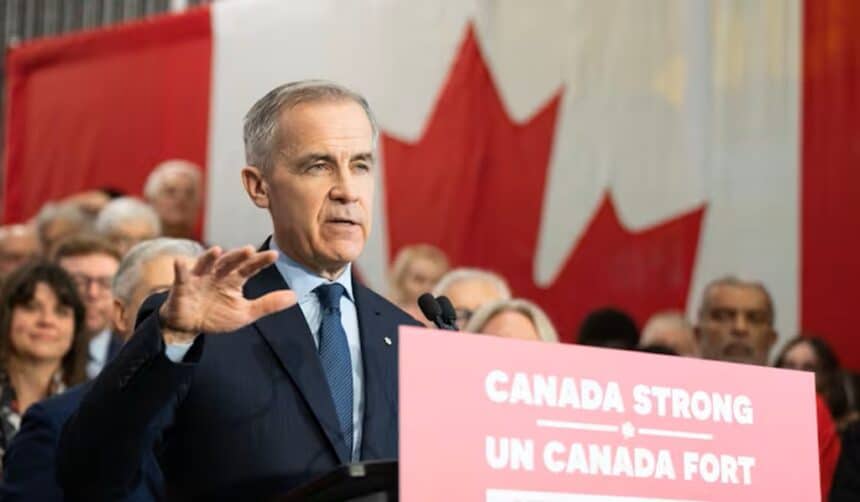
OTTAWA – Canadian Prime Minister Mark Carney announced that Canada will lift its retaliatory tariffs on U.S. goods covered by the United States-Mexico-Canada Agreement (USMCA). The policy takes effect September 1 and returns trade practices to where they stood before recent disputes.
Carney’s decision came at a time when Canada is struggling with high unemployment and a wave of investment moving to the United States. The change brings a mix of relief and criticism, renewing the trade status for most goods but raising questions about how Ottawa handles relations with Washington.
The government’s move comes after several tense months of trade friction between Canada and the United States. Tensions started when U.S. President Donald Trump set a 35% tariff on Canadian exports not protected by USMCA rules, accusing Canada of not meeting all agreement terms.
Those U.S. tariffs hit beginning August 1, targeting vital sectors like steel, aluminum, and autos. Some metals faced 50% tariffs, while auto tariffs reached 25%. In response, Ottawa set 25% tariffs on about C$30 billion of U.S. imports, hitting popular items like orange juice, clothing, and motorcycles.
While U.S. tariffs did not apply to the bulk of Canadian exports that follow USMCA guidelines—covering roughly 85% of Canada’s trade—Canada’s countermeasures sometimes included goods that should have stayed exempt. Carney’s Friday remarks confirmed that these counter-tariffs are ending, in line with USMCA rules and matching the U.S. approach.
“This step brings back free trade on almost all goods between our economies,” Carney explained at a press event in Ottawa. “It shows that Canada backs the USMCA and lets us focus on settling disputes in major industries, including steel and autos.”
Debate Over Trade Talks
Carney claimed the rollback would help “kick-start” trade discussions between Canada and the United States. He mentioned a recent phone call with President Trump and hinted at renewed talks to sort out ongoing issues. However, U.S. government sources quickly denied that any formal negotiations had started again.
A senior White House official stated that while the conversation with Carney was positive, no new trade talks are underway. President Trump echoed that, saying, “We had a good call, and we’re working on something. Carney’s a good guy, but Canada has to honour the deals in place.”
Opposition leader Pierre Poilievre was quick to challenge Carney’s version of events, accusing the prime minister of giving Canadians an inaccurate picture. “The Prime Minister talked tough but is now backing down and telling a story that doesn’t line up with reality,” Poilievre said. “Canadians need openness, not stories that don’t match what’s happening.”
Economic Pressure Mounts at Home
Canada’s shift on tariffs comes as the country faces heavy economic challenges. Unemployment has soared, hitting 7.8% in July—the worst level in more than ten years, according to Statistics Canada. Industries like steel, aluminum, and lumber, which rely on trade with the U.S., have seen significant job cuts.
At the same time, many Canadian companies have shifted investment to the United States. Concerns over tax breaks and promises of a more welcoming environment under the Trump administration have driven firms south, with the Toronto Stock Exchange down 12% since the latest round of tariffs. Manufacturing and energy companies have been hit especially hard.
Meredith Lilly, who once advised the Trudeau government, said, “Canada’s economy is in a tough spot. Unemployment is climbing, and money is leaving for the U.S. Ending tariffs may help with trade flows, but it won’t fix the bigger economic problems.”
Political Reactions Split
Business groups welcomed the move. Goldy Hyder at the Business Council of Canada called the change a smart step that cuts costs for firms using U.S. materials and backs the USMCA before next year’s review.
However, union leaders and some politicians called the rollback a concession to Washington. Lana Payne, head of Unifor, said, “Rolling back tariffs isn’t a goodwill gesture—it’s giving in. Auto, steel, and forest workers in Canada are suffering, and this doesn’t force the U.S. to change its tariffs.”
Looking to the future, Carney has talked about building stronger homegrown industries and expanding trade with other countries to reduce Canada’s reliance on the American market. Recent government plans include C$700 million in loans for the lumber sector and new legislation to speed up work on big projects like pipelines and nuclear plants.
These moves have met resistance from Indigenous communities and environmental advocates, who argue they put economic goals before sustainability and land rights.
As Canada heads toward the USMCA’s scheduled review, Carney’s government faces strong pressure to deliver real progress. For now, dropping tariffs gives some breathing room to exporters and manufacturers. But with no new trade negotiations and continued economic strain, many of Canada’s biggest challenges remain. All eyes are now on how Ottawa will keep its promise to grow a stronger and more stable Canadian economy.