




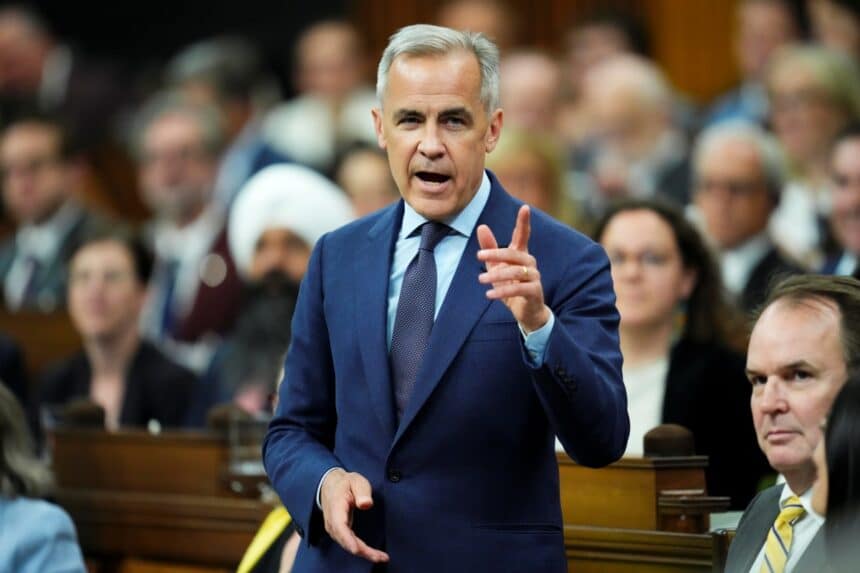
OTTAWA — In a fiery address to the House of Commons on Wednesday, Prime Minister Mark Carney renewed his sharp criticism of U.S. President Donald Trump, pinning Canada’s spiralling economic troubles squarely on the White House’s escalating trade war.
As inflation climbs to punishing levels, food bank visits shatter historical records, and the nation’s GDP growth grinds to a near-halt, Carney vowed to accelerate his government’s carbon-neutral agenda, framing it as the “only path to true sovereignty and resilience.”
“President Trump’s tariffs aren’t just a policy—they’re a rupture in the global economy, and Canada is paying the price,” Carney declared, his voice echoing through a packed chamber.
“From steel mills in Ontario to farms in the Prairies, American protectionism has hammered our workers and families. But we won’t bend. We’ll build back stronger, greener, and more independent.”
The remarks come amid a torrent of grim economic indicators that have fueled widespread discontent just six months after Carney’s stunning April election victory.
Carney’s Elbows UP
The former central banker swept to power on an “elbows up” platform, promising to stare down Trump and revive Canada’s fortunes. Yet, with polls showing his Liberal minority government clinging to a slim lead over Conservative Leader Pierre Poilievre, critics accuse Carney of deflection.
Canada’s annual inflation rate ticked up to 1.9 percent in August—the highest since early 2024—driven by soaring grocery prices and a rebound in gasoline costs after the abrupt cancellation of the consumer carbon tax in March.
Beef prices alone jumped 7.2 percent year-over-year, exacerbating what economists call a “sticky” cost-of-living crisis. Household staples like meat and dairy have risen 3.5 percent overall, forcing families to stretch budgets thinner than ever.
The human toll is starkly visible in food banks across the country. Food Banks Canada reported a staggering 2 million visits in March alone—the highest monthly figure on record, a 90 percent surge from pre-pandemic levels and six percent above 2023’s peak.
Nearly one-third of those seeking aid are children—about 700,000 minors monthly—while 18 percent of visitors hold jobs, the largest employed share ever tracked. In urban centers like Toronto and Vancouver, wait times have doubled, with volunteers rationing canned goods and fresh produce amid donations that can’t keep pace.
Canada’s Economy Contracting
Compounding the misery, Canada’s economy contracted by 1.6 percent in the second quarter, the sharpest quarterly drop in years and well below the G7 average. First-quarter growth limped in at just 0.5 percent, propped up temporarily by goods exports before tariffs bit harder.
Unemployment now hovers at 7.1 percent—the second-highest in the G7—leaving economists to warn of a “broadening malaise” if U.S. duties on autos, aluminum, and lumber aren’t eased.
Carney’s response? A defiant recommitment to carbon neutrality by 2050, unveiled alongside a $1 billion “Buy Canadian” relief fund and fast-tracked infrastructure projects.
Speaking from Edmonton, Alberta—heart of the oil sands— the prime minister touted “low-carbon oil and gas” exports as a bridge to a greener future, including liquefied natural gas terminals and nuclear expansions aimed at diversifying away from U.S. markets.
“We’re not retreating from climate action; we’re leading it,” he insisted. “Trump’s chaos demands we innovate—carbon capture tech, clean energy corridors, and incentives for polluters to pay up front, not at the pump.”
Carney Threading a Needle
The pivot builds on Carney’s March decision to scrap the consumer carbon tax, a move he hailed as “serving its purpose” but reframed as shifting the burden to big emitters through progressive regulations and subsidies.
Environmental advocates praise the ambition, with Green Party Leader Elizabeth May calling it “a market-driven masterstroke.” Yet, Poilievre slammed it as “greenwashing the pain,” arguing the agenda ignores immediate relief for “truckers and welders crushed by tariffs and taxes.”
Analysts see Carney threading a needle: His approval ratings, buoyed by anti-Trump nationalism, hover at 50 percent, but economic anxiety is eroding support in rust-belt ridings. “Carney’s betting on long-term green jobs to offset short-term tariff hits,” said CIBC economist Andrew Grantham. “But with GDP in the gutter and pantries bare, voters may demand quick wins over 2050 visions.”
As the fall session heats up, Carney faces a confidence vote and potential U.S. talks. Trump, meanwhile, dismissed the barbs on Truth Social: “Carney’s whining—Canada’s economy is ours to fix. Join the 51st state or pay up!”
For now, the prime minister’s gamble hangs on whether Canadians buy his blend of defiance and decarbonization—or see it as doubling down on denial.