





TORONTO – Prime Minister Mark Carney’s recent decision to halt Air Canada’s strike using Section 107 of the Canada Labour Code has caused a surge of anger not only among flight attendants, but also across the broader labour movement.
What started as a direct attempt to control disruption for travellers has evolved into a moment of crisis for the Liberal government, exposing the gap between pro-worker promises and current policies.
Rather than achieving “industrial peace,” the rushed back-to-work order has only deepened frustration and created a wave of support for striking workers, with unions uniting and public opinion shifting fast.
On August 16, 2025, more than 10,000 Air Canada flight attendants, represented by the Canadian Union of Public Employees (CUPE), walked off the job. Their core demands were simple: pay for ground duties like boarding and safety checks, and fair wages that match rising costs.
Many new staff make only $1,952 per month, which falls below federal minimum wage once unpaid labour is counted, especially as inflation has cut real wages by close to 70% since 2000.
At the same time, Air Canada’s CEO, Michael Rousseau, took home $12.5 million last year—a number that has fuelled resentment among workers. CUPE’s 99.7% vote in favour of striking, from nearly total turnout, made it clear that staff were tired of delays in bargaining.
Within hours of the walkout, Jobs Minister Patty Hajdu stepped in. By invoking Section 107 to send the matter to the Canada Industrial Relations Board (CIRB) for binding arbitration, the government hoped to quickly restore normal operations for the 700 daily flights serving 130,000 travellers.
Instead, the move became a flashpoint. It drew criticism from union leaders and brought new energy to Canada’s wider labour movement.

Air Canada Workers Refuse to Back Down
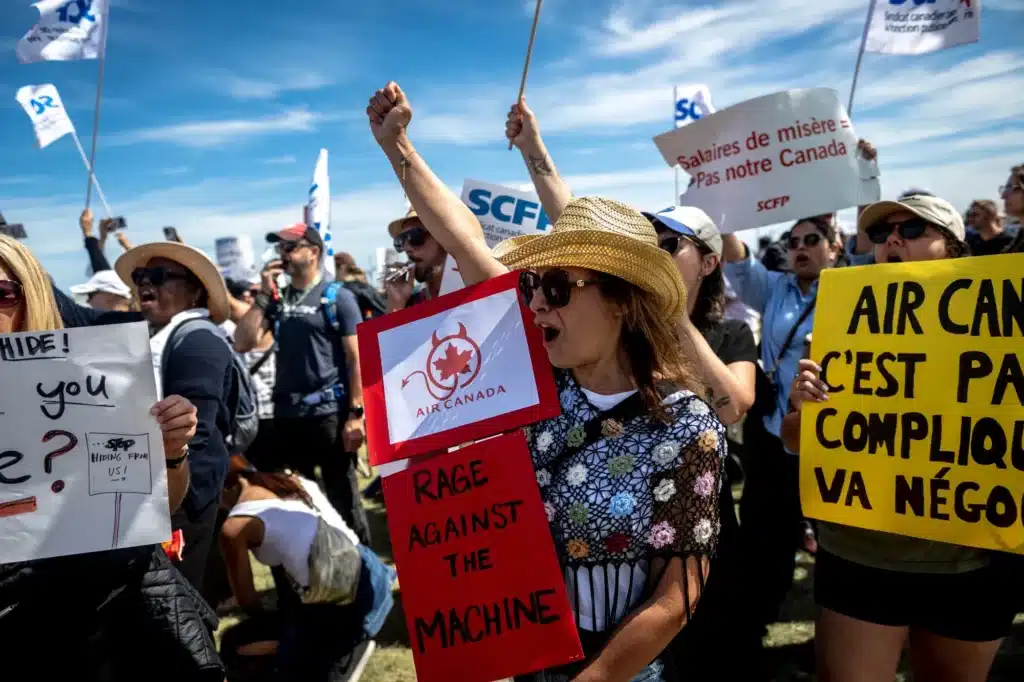
Instead of stopping the strike, Carney’s order gave strikers new resolve. On August 17, CUPE National President Mark Hancock tore up the CIRB’s first back-to-work order outside Toronto’s Pearson International Airport, declaring that he would go to jail if needed.
Even after the CIRB ruled the strike illegal on Monday and ordered staff back by noon, CUPE stood firm. Picket lines held strong in Toronto, Montreal, Calgary, and Vancouver. Now, the union is taking the matter to federal court, saying the order breaches their Charter right to strike.
These actions bring to mind past resistance from Canadian unions. In the early 1980s, labour leaders like Jean-Claude Parrot and Grace Hartman were jailed for defying similar laws, showing how rare and momentous these moments can be. Steven Tufts, a labour expert at York University, said that real progress for workers often happens at the picket line rather than through forced settlements.
The defiance of Air Canada flight attendants has become a call to action for unions across the country. On August 17, their picket lines drew support from Unifor, OPSEU, COPE, ETFO, the International Association of Machinists, the Teamsters, and the International Brotherhood of Electrical Workers.
The Canadian Labour Congress is feeling pressure to coordinate broader protest actions, similar to what happened in the 2022 Ontario education workers’ strike. That strike nearly led to a province-wide work stoppage and forced Premier Doug Ford to withdraw a back-to-work order.
Gil McGowan, president of the Alberta Federation of Labour, called the federal response “an abomination” that undermines the right to strike—a key part of fair bargaining, upheld by the Supreme Court since 2015.
He warned that if Section 107 is used this way, provinces might follow suit, making it even harder for workers to stand up for themselves.
Liberals Face Credibility Crisis with Workers
The Liberals’ image as a party for workers is taking a hit. CUPE National Secretary-Treasurer Candace Rennick accused the government of “corporate bias” and betrayal, especially since a large majority of flight attendants are women seeking fair pay.
The repeated use of Section 107—blocked unions in aviation, postal service, rails, and ports before—has only strengthened claims that Ottawa looks out for big companies before employee rights. Air Canada, which had asked for government help, is seen as having an insider advantage.
Doubts about government impartiality have also grown, as CIRB chair Maryse Tremblay once worked as legal counsel for Air Canada. Social media posts echo the frustration, highlighting the contradiction between promises to defend workers’ rights and current government actions. Opinions calling Carney “out of touch” reflect a growing gap between Liberal leaders and their working-class supporters.
Carney’s win in 2025 owed much to his promise of defending Canadian interests. But his swift move to stop the Air Canada strike has cost him support, especially among workers.
Polls posted by rabble.ca show that 59% of Canadians think the government should respect the right to strike, even with the resulting delays, while just 24% support intervention. Critics say Carney, with a background at the Bank of England, is serving corporate donors more than ordinary Canadians.
A Turning Point for Canada’s Labour Movement
The Conservatives have seized the moment by supporting flight attendants. Labour Critic Kyle Seeback is now calling for a law that would guarantee pay for ground duties—dubbed the “Fairness for Flight Attendants Act.” Carney is now stuck between big business allies and working Canadians, with criticism from both sides growing louder.
The current standoff at Air Canada is shaping up as a central fight for workers in Canada. Flight attendants, with strong union backing, are challenging how far governments can go to limit the right to strike.
The ongoing dispute has left over 500,000 travellers stranded, but underlines the larger issue of unpaid work and fair treatment. CUPE is pushing its case in court, pointing out that U.S. airlines like Delta and American already pay staff for duties now unpaid in Canada.
With public attention fixed on the crisis, Carney must decide whether to rebuild trust with working Canadians or continue down a path that many see as backing corporate power over everyday people. For now, picket lines remain, and union solidarity is stronger than ever. As Mark Hancock put it, workers plan to keep fighting, regardless of government efforts to silence them.