




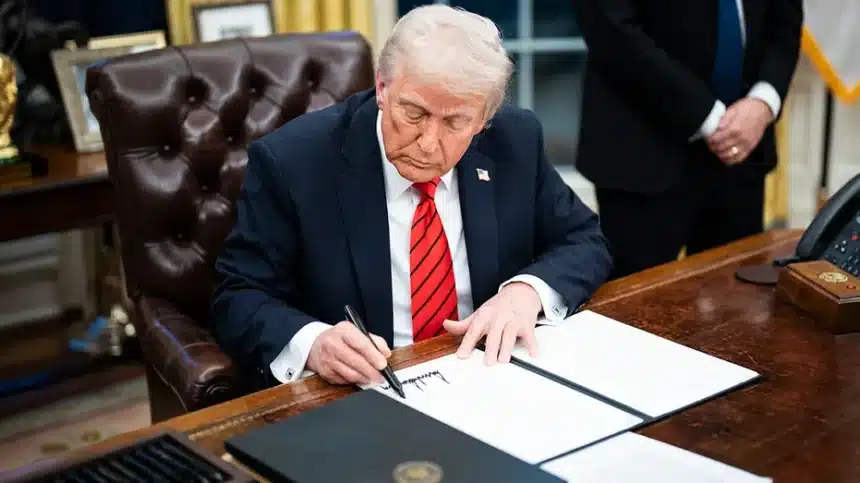
OTTAWA – The United States has sharply escalated trade tensions with Canada, as President Donald Trump signed an order raising tariffs on Canadian goods to 35%, up from the previous 25%.
The decision, effective immediately, adds more pressure on Canada’s economy and comes at a challenging time for Prime Minister Mark Carney. The newly elected leader has struggled to secure results in high-stakes talks with Washington.
Critics say Carney’s choice to take a back seat in discussions, combined with relying on former Liberal ministers and even seeking advice from former Conservative Prime Minister Stephen Harper, has put Canada in a vulnerable spot as the country faces growing economic risks and rising inflation.
Trump justified the move in a post on Truth Social Thursday night, accusing Canada of “protectionist policies” that harm American farmers and manufacturers. He cited Canada’s steep tariffs on U.S. dairy and hurdles for American agriculture at the border.
“Instead of working with us, Canada hit back with their own tariffs,” Trump wrote. “So, starting August 1, 2025, we’re applying a 35% tariff on Canadian imports, separate from other sector-specific tariffs.”
This latest order builds on earlier measures from March, when Trump imposed a 50% tariff on Canadian steel and aluminum, plus a 25% tariff on cars not covered by the United States-Mexico-Canada Agreement (USMCA).
While USMCA-compliant goods remain exempt, the new tariffs will affect roughly $256 billion worth of Canadian exports based on 2024 trade numbers, with most USMCA trade excluded. Last year, Canada exported $412.7 billion in goods to the U.S., making these tariffs a serious hit to its export-focused economy.
Trump also repeated claims that Canada acts as a route for fentanyl entering the U.S., though U.S. Customs figures show only a small fraction of fentanyl seizures happen at the northern border. “If Canada helps stop the fentanyl flow, we may consider changing this policy,” Trump added, leaving the door open but making no clear promises.
Carney Faces Mounting Criticism Over Trade Approach
Since taking office in April, Mark Carney has faced growing doubts over his handling of the trade dispute. He had campaigned on economic strength and promised a strong defence of Canadian interests, yet many feel he’s been absent when leadership is needed most.
Instead of leading the talks himself, Carney put former Trudeau-era ministers like Dominic LeBlanc and Ambassador Kirsten Hillman in charge. Opponents say these figures struggled during the last USMCA negotiations and question their ability to secure better terms now.
Pierre Poilievre, Conservative Leader, was blunt: “Carney campaigned as a top negotiator, but has been missing in action. Putting the same team that fumbled NAFTA back in charge is asking for trouble.” These feelings are shared by many on social media, with some calling Carney’s “elbows up” promise empty.
In a surprising twist, Carney reached out to Stephen Harper, the former Conservative PM known for brokering major trade deals like the Canada-EU pact.
Former Prime Minister Stephen Harper revealed Carney sought his input on how to handle Trump’s aggressive tactics, though Harper’s role is said to be informal and advisory.
“It’s extremely rare for a Liberal PM to seek such public advice from a Conservative predecessor,” noted Daniel Beland, political scientist at McGill. “It suggests both a sense of urgency and a lack of faith in his current team.”
Campaign Promises Clash With Reality
During the 2025 election, Carney repeatedly highlighted his negotiation skills from his time at the Bank of Canada and the Bank of England. In a CBC interview, he boasted about standing up to tough leaders and promised to shield Canadian jobs from U.S. protectionism.
“I’ve done high-pressure deals my whole career,” Carney told viewers. “Canadians can count on me to stand up to Trump.”
But his record since becoming Prime Minister has led to sharp criticism. In June, Carney cancelled a planned digital services tax on U.S. tech giants after Trump threatened to halt trade talks. Many viewed this as giving in to American pressure.
Canadian negotiators had hoped for a new trade and security pact by July 21, but Trump’s tariffs have derailed those plans. “Carney keeps getting outplayed,” said Julian Karaguesian, economics lecturer at McGill. “His tough talk hasn’t led to results.”
Supporters of Carney say he’s dealing with an unpredictable President whose trade stance changes quickly. “Trump never stays on one position for long,” said Carney’s spokesperson, Emily Williams. “The prime minister is working hard to protect Canada’s interests.” Still, Carney’s choice to let others handle talks rather than leading them continues to draw criticism.
Economic Impact: Inflation and Uncertainty Grow
The new 35% tariffs are likely to hit Canada’s economy hard, risking higher prices and job losses. The U.S. takes in about three-quarters of all Canadian exports. Sectors like lumber, pharmaceuticals and auto parts, all closely linked to U.S. supply chains, are bracing for higher costs.
The Yale Budget Lab estimates that, combined with Canada’s tariffs, these steps could shrink the Canadian economy by 2.1% over time and raise the chance of a downturn.
Inflation, already troubling many households, is expected to get worse as companies pass increased costs on to shoppers. Canadian prices climbed 2.7% during the year leading to June 2025, and some economists believe the new tariffs could push inflation close to 3.5% by year’s end. “Tariffs are a direct hit on consumers,” said U.S. Senate Minority Leader Chuck Schumer.
“Both Americans and Canadians will feel the pain.” Everyday products, from clothing to appliances to food, are expected to become more expensive—continuing a trend already seen with U.S. tariffs on goods from other countries.
The dispute has also clouded the business climate in Canada. Companies now face more uncertainty and are delaying investment or expansion plans. “It’s not just the tariffs, it’s the uncertainty they cause,” Karaguesian said. Canadian manufacturers, already coping with earlier U.S. steel and aluminum tariffs, now risk losing ground to American competitors.
Canada Weighs Response: Strike Back or Hold Back?
Late Thursday, Carney posted on X (formerly Twitter) to say he would keep fighting for Canadian businesses and workers but stopped short of announcing new tariffs in reply. “Throughout these trade talks, our government has defended Canadian workers and business interests,” he wrote. “Canada has made progress on tackling the fentanyl crisis in North America.”
Canada has usually responded in kind to U.S. tariffs—applying $20.7 billion in duties on American goods in March, and a 25% tariff on non-USMCA vehicles in April. However, in July, Carney paused plans to double tariffs on U.S. metals after signs of further escalation. Ontario Premier Doug Ford, a strong proponent of retaliation, has urged tougher action, warning that Trump’s tariffs could do real damage to Ontario’s manufacturing sector.
Meanwhile, Carney’s push to diversify Canada’s trade partners is picking up speed. His government has fast-tracked big domestic projects, like oil pipelines and nuclear plants, to help industries at home and reduce reliance on the U.S. Talks to boost trade with the European Union and United Kingdom are also in motion, but analysts doubt these markets can fully replace what Canada stands to lose if U.S. tariffs persist.
A Strained Cross-Border Relationship
This sharp hike in tariffs has deepened the strain between Canada and the U.S.—two countries whose economies are closely linked. Trump’s remarks about making Canada the “51st state” have angered many Canadians, fuelling a sense of nationalism. Carney, elected to push back against U.S. overreach, now finds himself juggling economic concerns with a need to defend Canada’s independence.
With the August 1 deadline here, Canadian trade teams are still trying to secure a deal. Yet Trump’s unpredictable stance and Carney’s quieter leadership style have left experts skeptical about a quick solution. “Trump can change his mind without warning,” said Doug Ford. “You might think you’ve worked something out, and the next day you get hit with a 35% tariff.”
Jobs, inflation, and the future of Canada’s trade with its biggest partner all hang in the balance. Carney made big promises to protect Canadians. The coming weeks will show if his team can reset the relationship or if his first months in office will be defined by failing to stand up to American pressure.